When someone talks about Home Health Care, it isn’t just always about how care is provided, but more about the complexities in the system itself, since it is one of the most logistically complex environments in healthcare.
Your team is working across dozens of different locations every single day. Your patients have unique care plans that change often. The billing requirements are dense, the compliance obligations are serious, and the caregivers are actually working in isolation with easy access to the information they need.
Home health care software is built to solve exactly the same problem. This guide breaks down what it actually is, what the best these platforms do, and how agencies can use it to deliver better and enhanced care, and run even more efficiently.
What is Home Health Care Software?
A digital platform that is designed for agencies that deliver medical or personal care services in patients home, is exactly what a Home Health Care Software provides. It centralizes the patient records, caregiver scheduling, documentation visiting, billing, and compliance reporting all into one single system.
Unlike hospital or clinic software, home health platforms are built around the specific reality of mobile caregiving, where your team is always on the move, documentation happens in the field, and coordination across multiple patients and caregivers has to be seamless.
The best platforms are cloud-based, accessible on any device, and designed to reduce the time caregivers spend on paperwork so they can spend more time with patients.
The core challenges home health agencies face without the right software
Before diving into features, it’s worth understanding what agencies are actually dealing with when they rely on manual or fragmented systems:
Scheduling chaos. Coordinating caregivers across dozens of patient homes, managing shift changes, handling last-minute call-outs, without a centralized scheduling system, this becomes an administrative nightmare that consumes hours every week.
Documentation gaps. When caregivers document visits on paper or after the fact, details get lost, timing becomes inaccurate, and the clinical picture becomes incomplete. This creates both care risks and billing problems.
Billing errors. Home health billing is notoriously complex. Missed visits, undocumented services, and coding errors cost agencies revenue and create compliance exposure.
Communication breakdowns. A caregiver on the other side of town has no easy way to flag a change in a patient’s condition, ask a clinical question, or receive an updated care plan, unless there’s a system in place.
Compliance pressure. State licensing, Medicare/Medicaid requirements, HIPAA standards, the regulatory landscape for home health agencies is demanding. Manual documentation makes compliance audits stressful at best, catastrophic at worst.
Key Features of Home Health Care Software
- Patient Management
A complete patient profile system, covering medical history, care plans, physician orders, medication lists, emergency contacts, and visit history, gives every caregiver the context they need before they walk through a patient’s door. Updates in real time. Accessible from any device.
- Caregiver Scheduling
Smart scheduling tools match caregivers to patients based on availability, skills, location, and continuity of care preferences. Automated reminders reduce no-shows. Real-time schedule changes are communicated instantly. GPS-based visit verification confirms that caregivers are where they’re supposed to be.
- Point-of-care Documentation
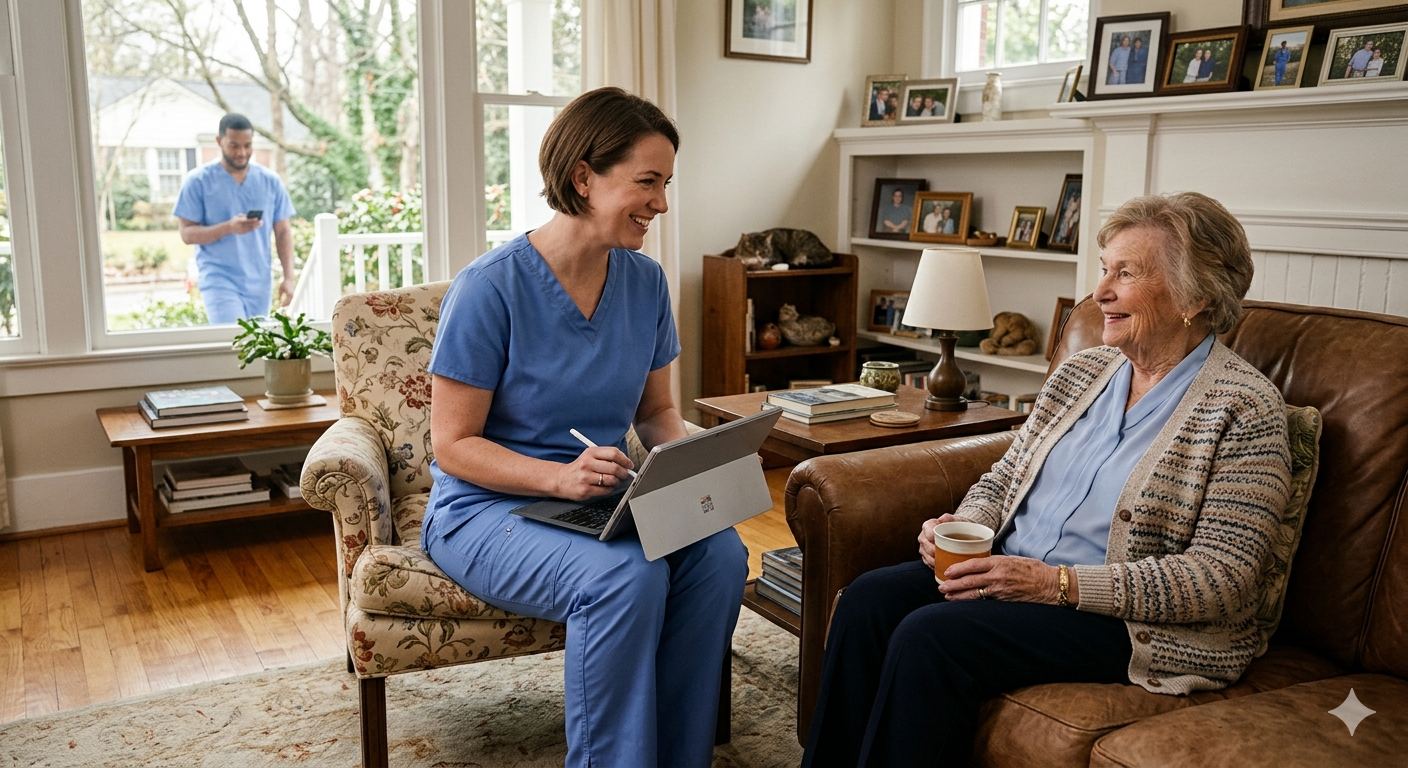
Mobile-friendly documentation tools let caregivers record visit notes, vitals, medication administration, and task completion right at the bedside, on a smartphone or tablet. This is one of the highest-impact features in the entire category. Real-time documentation means more accurate records, fewer billing errors, and better clinical outcomes.
- Billing and Revenue Cycle Management
Home health billing involves multiple payers, private pay, Medicare, Medicaid, and private insurance, each with their own requirements. Good software automates claim generation, tracks authorizations, flags billing errors before submission, and integrates with major billing platforms to reduce days in accounts receivable.
- Compliance and Reporting
Automated compliance tracking, audit logs, HIPAA-compliant data storage, and state-specific reporting tools ensure your agency stays inspection-ready. The best platforms generate compliance reports on demand so you’re never caught off guard.
- Communication Tools
Secure messaging between caregivers, supervisors, and clinical teams. Family portals for transparency. Physician communication features for care plan updates. In home health, communication is care, and the software needs to support it.
How Home Health Software Improves Patient Outcomes
The connection between software and patient outcomes might not be immediately obvious, but it’s direct and significant.
Care plan adherence improves when caregivers have instant access to current instructions. Medication errors drop when eMAR systems flag missed doses and contraindications. Early warning signs are caught sooner when vital sign trends are tracked digitally over time. Rehospitalization rates decline when care is coordinated, documented, and monitored consistently.
For agencies serving Medicare patients, reduced rehospitalization has direct financial implications, both in terms of value-based care incentives and in protecting agency reputation scores.
What Makes a Great Home Health Software Program
With many platforms competing in this space, here’s what separates good from great:
Mobile-first design. If your caregivers can’t easily use the platform on their phone, they won’t use it properly. Look for apps built for the field, clean, fast, and intuitive on a small screen.
Offline capability. Home visits happen in areas with poor connectivity. The best platforms allow offline documentation that syncs when a connection is restored.
Integration ecosystem. Does the software connect with your EMR, your billing platform, your telephony system? Fragmented integrations mean fragmented data.
Training and support. Even great software fails without proper onboarding. Look for vendors who provide real implementation support, not just a video library.
Security. HIPAA compliance is the floor, not the ceiling. Look for platforms with role-based access controls, audit trails, and encrypted data both in transit and at rest.