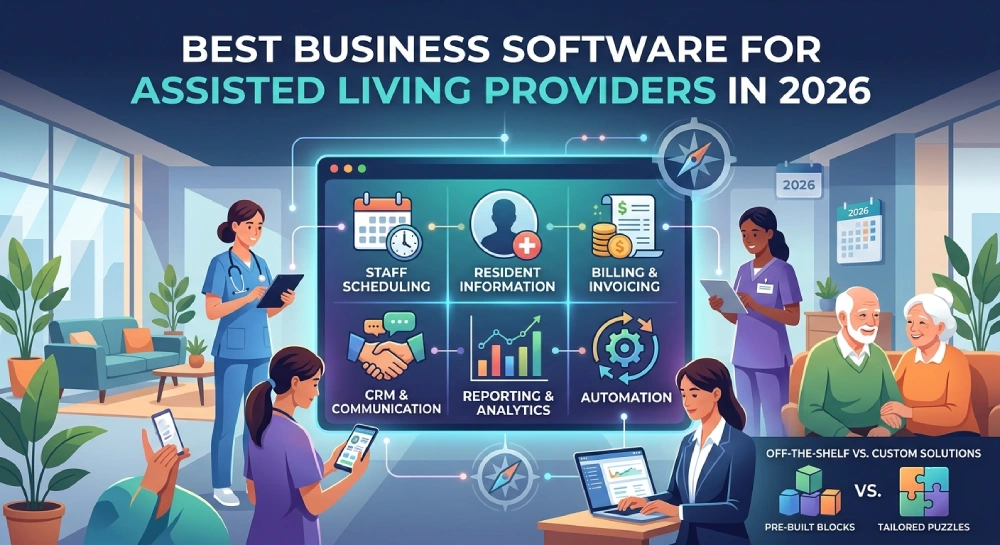
Running an assisted living facility involves more than resident care. Providers also manage staff schedules, attendance, resident information, communication, billing, and daily administration. Business software for assisted living providers can bring these tasks together, reduce manual work, and automate repetitive processes.
The right solution can support scheduling, CRM, billing, reporting, communication, and integrations while fitting the provider’s specific needs.
What Is Business Software for Assisted Living Providers?
Assisted living providers can benefit from business software to handle important operational and administrative tasks. It could contain scheduling, attendance tracking, CRM, reporting, billing, communication, and automation, to name a few of the features, contingent upon the platform.
Ideally, the best solution would facilitate daily workflows without causing any complexity.
What Features Should Business Software for Assisted Living Providers Include?
Useful features include:
- Staff scheduling
- Attendance tracking
- Resident information management
- CRM platforms
- Reporting and analytics
- Billing and invoicing
- Communication
- Software automation
- Software integration
- Mobile access
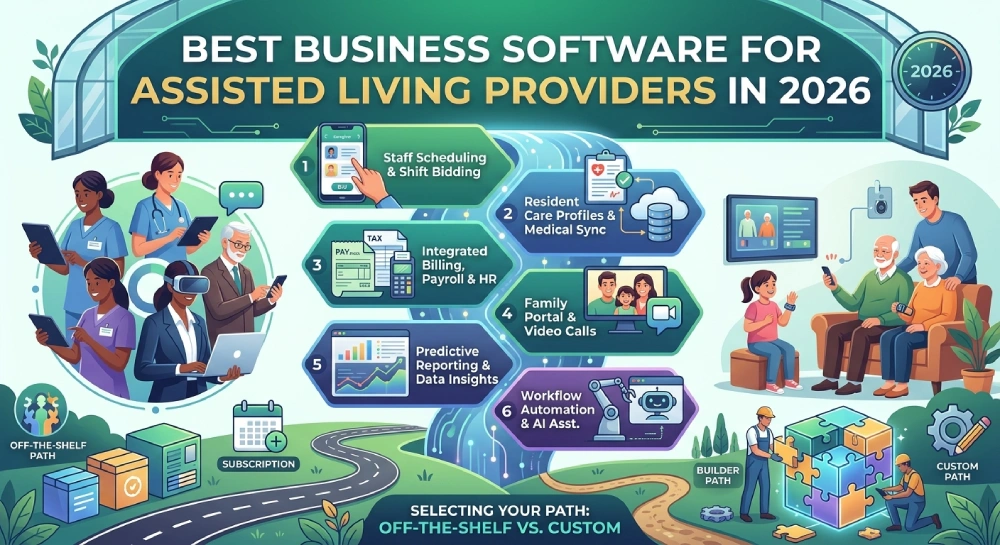
Off-the-Shelf vs. Custom Software: What Is the Difference?
Off-the-shelf software is pre-programmed software used by a wide variety of businesses. It can be implemented relatively quickly and may be less expensive initially.
Custom software development provides a system for certain business processes. It provides greater software customization, but usually requires more time and investment.
What Are the Benefits of Custom Software?
The main custom software benefits are flexibility and control. Custom software can be designed around existing workflows without requiring staff to significantly change how they work.
Custom solutions can provide:
- Customized workflows
- Better software scalability
- Tailored integrations
- Custom reporting
- Automated processes
- Greater feature control
When Is Off-the-Shelf Software the Better Choice?
When a facility requires basic features and needs to get up and running quickly, off-the-shelf tools can be effective.
They may be appropriate if high-level customization isn’t required, and you’d like to know the subscription fee in advance.
Custom Software vs. Off-the-Shelf: Key Differences
| Factor | Off-the-Shelf | Custom Software |
| Setup | Faster | Takes longer |
| Customization | Limited | High |
| Cost | Usually lower upfront | Usually higher upfront |
| Scalability | Depends on provider | Built around your needs |
| Integration | Varies | Can be tailored |
| Automation | Prebuilt | Customizable |
The better choice depends on whether speed or flexibility is the bigger priority.
How Can Business Software Improve Assisted Living Operations?
Good software can help automate repetitive administrative tasks and provide management with more visibility into operations.
Automated scheduling can minimize manual coordination, for instance, or centralized information can make it easier to access important information.
Can CRM Platforms Help Assisted Living Providers?
Yes. CRM will help you track interactions with prospective residents, families, referral sources, and others.
A CRM can be used to centralize inquiries, follow ups, communication history, and lead information.
How Do Scheduling and Attendance Software Support Assisted Living Facilities?
Managers of assisted living facilities can schedule staff availability, coverage and shifts with scheduling software.
Meanwhile, attendance software for assisted living providers can help track working hours and attendance, supporting payroll and workforce management. It can have the following useful features:
- Shift scheduling
- Availability tracking
- Time and attendance
- Overtime tracking
- Shift reminders
- Staff notifications
What Role Does Software Integration Play?
Software integration facilitates the sharing of information between two or more systems. This can help limit redundant data entry when it comes to scheduling, CRM, billing, payroll, and other applications.
Make sure the software you choose supports the integrations you need and check for any additional fees.
When Should You Consider Software Modernization?
When there are outdated, disconnected, hard to maintain, or growth-challenged software systems, software modernization can be helpful.
Warning signs include frequent manual work, duplicate data entry, limited reporting and poor integrations.
How Much Does Custom Software Cost?
There are a number of factors that determine custom software cost, such as features, integrations, technology, security needs, and development time.
A basic application will likely provide a lower amount of investment as compared to a full platform that includes scheduling, CRM, billing, automation, and reporting.
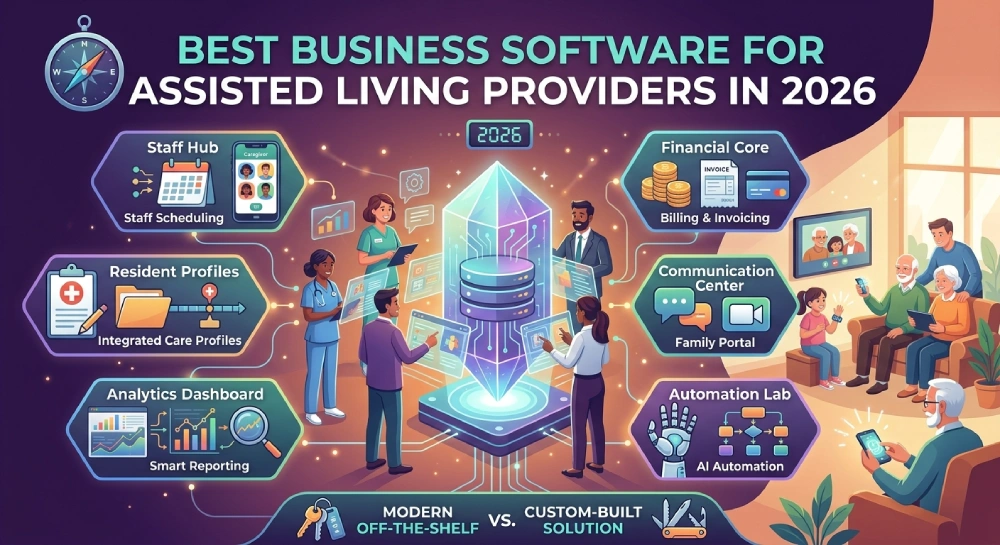
How to Choose the Right Business Software in 2026
Start by identifying the facility’s biggest operational challenges. Then compare solutions based on features, ease of use, security, integrations, scalability, support, and total cost.
Ask these questions:
- Does it solve the main problems?
- Can staff learn it easily?
- Does it integrate with existing systems?
- Can it scale with the facility?
- What support is provided?
- What are the ongoing costs?
Conclusion
Business software with the most features is not always the best software. It is what is best for the provider’s workflows, staff, budget and growth plans.
Off-the-shelf software is fast and convenient, while custom software offers greater flexibility. Making a side-by-side comparison can help providers make a smarter software investment.
Frequently Asked Questions
What is business software for assisted living providers?
This software should be able to help you with tasks like scheduling, attendance, resident management, communication, reporting, billing, CRM, and workflow automation.
What is the difference between custom software and off-the-shelf software?
Off-the-shelf software is designed for a wide range of markets while custom software focuses on the processes and needs of a certain organization.
Is custom software better than off-the-shelf software?
Not always. Off-the-shelf solutions are typically quicker and simpler to install, and custom software can be more flexible. The right one will be selected depending on business requirements.
What are the main custom software benefits?
Customized workflows, flexible integrations, scalable features, specialized reporting, and automation tailored to specific operational needs are among the benefits.
How much does custom software cost?
There is a price to be determined based on features, integrations, technology, security and development time. Normally, there is a definite project scope that needs to be defined to arrive at an accurate estimate.
Can business software improve assisted living scheduling?
Yes. Automating staff availability, shifts, coverage, reminders and changes with scheduling software minimizes the manual coordination.
What should scheduling software for assisted living facilities include?
Useful features include shift planning, staff availability, notifications, coverage tracking, time management, overtime tracking, and mobile access.
How can attendance software help assisted living providers?
It can record employee hours, track attendance, support payroll processes, and give managers clearer information about staffing and working hours.
Can business software integrate with existing CRM platforms?
Many systems provide integrations or APIs that allow connections with CRM platforms and other applications. Compatibility should be checked before purchase.
When should an assisted living provider invest in software modernization?
Modernization may be appropriate when existing systems are outdated, disconnected, difficult to maintain, or creating too much manual work.