
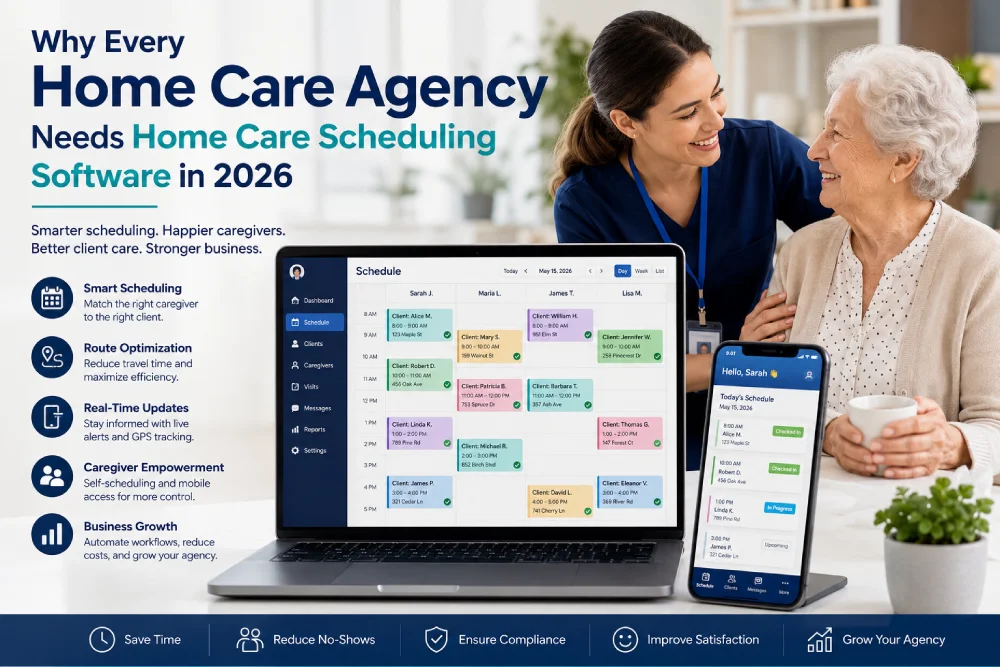
Home care agency scheduling software without proper software is a nightmare. Phone calls, spreadsheets, sticky notes. It is chaotic. Caregivers get double-booked. Visits get missed. Clients get frustrated. Staff get burned out.
Home care scheduling software for home healthcare agencies is not just about filling shifts. It is about running a sustainable business. Without crm for home care, agencies drown in admin work. With it, they grow.
Let us walk through why this technology is essential in 2026 to use home care agency management software.
The Scheduling Problem That Keeps Agency Owners Up at Night
Scheduling is the most complex operational challenge in home care scheduling software. Matching caregivers to clients based on availability, skills, location, and preferences is a puzzle that gets harder with every new client. When done manually, it eats up hours of admin time and still produces errors.
A survey found that 54% of home care leaders view scheduling as one of the most important systems for their agency’s success . That is because scheduling sits at the intersection of everything that matters. Care quality, staff retention, client satisfaction, and revenue all depend on getting schedules right.
Poor scheduling leads to longer and less predictable workdays, excessive drive time, inconsistent caregiver-client relationships, and highly licensed staff being assigned to visits that do not require their skill level . Over time, these patterns erode trust and drive caregivers away.

What Home Care Scheduling Software Actually Does
Good home care scheduling software does much more than put names on a calendar. It automates the entire process from shift creation to visit verification.
- Smart matching: Algorithms match caregivers to clients based on availability, specializations, location, and personal care agency software preferences . This means the right caregiver gets paired with the right client every time.
- Route optimization: The software groups visits geographically and calculates travel times between consecutive visits . This reduces drive time and prevents caregivers from zigzagging across a territory.
- Real-time visibility. Office staff can see who is where at any moment. If a caregiver is running behind, alerts go out automatically . GPS visit verification confirms arrivals and departures.
- Self-scheduling: Caregivers can view their schedules, pick up open shifts, and manage availability from a mobile app. This gives them more control and reduces the administrative burden on office staff.
- Automated workflows: Approved shifts flow directly into payroll and invoicing. No double entry. No reconciliation headaches.
The Financial Case for Scheduling Software
Agencies that invest in home care scheduling software see measurable returns. Some platforms claim to automate up to 95% of visit types and 64% of workflow tasks, allowing agencies to increase patient census without hiring more schedulers .
MedArrive’s platform, developed with ChristianaCare, has demonstrated the ability to cut visit times for certain services by up to 50% . That is real capacity freed up without adding staff.
For growing agencies, the math is simple. Manual scheduling does not scale. As the number of clients and caregivers grows, the time required to manage schedules grows exponentially. Software keeps administrative costs flat while revenue grows.
Key Features of a high-quality home care agency to Look For
When choosing home care scheduling software, look for these essentials:
- User-friendly interface. The software should be intuitive and easy to navigate. Complex interfaces lead to errors and frustration for home health care scheduling software.
- Mobile accessibility. Caregivers need to view and update schedules from their phones. Push notifications keep everyone informed of changes.
- Integration with other systems. The software should connect with EHR, payroll, and billing software for home health care. Data should flow seamlessly to eliminate duplicate entry.
- Customizable scheduling. Different agencies have different needs. The software should accommodate different visit types, shift patterns, and workflows.
- Real-time updates. Instant notifications of changes, cancellations, or new appointments prevent conflicts and keep everyone informed.
- Compliance support. Automated documentation, audit trails, and alerts for certification renewals help agencies stay compliant.
- Reporting and analytics. Dashboards that track key metrics like fill rates, overtime, and utilization help leaders make data-driven decisions.

The 2026 Shift: Automation with Human Oversight
The latest home care scheduling software goes beyond basic automation. It supports clinical leaders by building schedules days in advance, dispatching visits in real-time, and using rules-based logic to distribute work evenly across the workforce.
The most effective solutions support, not replace, human oversight. Schedulers review and confirm before finalizing. Clinical leaders maintain control while the manual burden is reduced.
This is a critical distinction for home health scheduling software.
Conclusion
Home care scheduling software is not optional anymore. This is what separates an agency that actually works from one that’s always losing staff and clients.
The right software takes care of matching, maps out the best routes, shows you what’s happening in real time, and plugs right into your payroll and billing. It cuts down the busywork, keeps your people from burning out, and lets you grow without adding more overhead.
For home care agencies in 2026? It’s not about whether you get scheduling software – it’s about how soon you can get it up and running.
Frequently Asked Questions
What is home care scheduling software and what does it do?
It matches caregivers with clients based on who’s available and what skills they got, figures out the best routes, tracks visits as they happen, and hooks right into payroll and billing
Why is scheduling software important for home care agencies
Because scheduling is the biggest headache in home care. Do it by hand and you’re gonna get errors, double-books, burned-out staff, and lost money.
What features should I look for in scheduling software?
You want something easy to use, works on phones, connects with your other systems, lets you customize schedules, updates in real time, keeps you compliant, and gives you solid reports.
Can scheduling software help with caregiver retention?
Features like self-scheduling and predictable hours give caregivers more say in their own lives.
How much time does scheduling software save?
Some platforms say they automate up to 95% of visits and 64% of workflow tasks. That means you can grow your agency without needing to hire more schedulers.
Is scheduling software expensive?
Prices vary. But it pays for itself. Less admin work, fewer screw-ups, more capacity – it’s a smart investment.
Does scheduling software integrate with payroll and billing?
Yes. Approved shifts flow right into payroll and invoices. No double data entry. No mistakes.
What is GPS visit verification?
It’s a feature that uses GPS to confirm when a caregiver shows up and leaves. Keeps you compliant and gives you real-time visibility.
Can caregivers use scheduling software on their phones?
Yes. Most platforms have apps so caregivers can check schedules, pick up shifts, manage availability, and get updates on the go.
How does scheduling software improve client satisfaction?
It makes sure the right caregiver shows up for the right client.